Suzanna Travels to
Cambodia
Click here to
see Vietnam part of this trip
Trip Journal
The Spirit of Vietnam Tour and The Road to Angkor
Tour
from Adventure Center - Intrepid Tours (www.intrepidtravel.com) 1311 63rd Street Suite 200 Emeryville CA 94608 (501) 654-1879
November 15, 2001 to December 5, 2001
.jpg)
Day 1 to Day 9 - Click here to go to Vietnam part of this
trip
Day 10 - Tuesday Nov 27 (Day 1 of the Cambodia Road to Angkor Tour) - Ho Chi Minh City (Saigon)
Day 11 - Wednesday Nov 28 (Day 2 Cambodia Tour) - Bus and Ferry ride from Vietnam to Cambodia
Day 12 - Thursday Nov 29 (Day 3 Cambodia Tour) - Phnom Penh, Cambodia -
Killing Fields, Tuol Sleng
Prison Museum, Royal Palace Silver
Pagoda, Dinner
Day 13 - Friday Nov 30 (Day 4 Cambodia Tour) - Fly to Siem Reap,
Cambodia
Priah Khan, Ta Prohm,
Tay Ninh Mountain
Day 14 - Saturday Dec 1 (Day 5 Cambodia Tour) - Siem Reap - Angkor Wat
Ankor Wat, Angor Thom,
Bayon, Terrace of Elephants & Leper King
Day 15 - Sunday Dec 2 (Day 6 Cambodia Tour) - Siem Reap
Bantey Srei Citadel of the Women,
Baray Lake Swim
Day 16 - Mon Dec 3 (Day 7 Cambodia Tour) - Siem Reap to Bangkok to Kuala Lumpur to Taiwan to Los Angeles to Atlanta
Malaysia
Back to top
Day 10 (tour
day 1) Vietnam Cambodia Trip Tuesday
Nov 27 - Ho Chi Minh City (Saigon)
Day 10 of my Vietnam/Cambodia trip is Day 1 on the Cambodia Road to Angkor Tour.
**Breakfast** Free day in Saigon Vietnam
Intrepid Itinerary: You and your fellow travellers will be arriving at all times from around the world today, so there are no arranged activities for the daytime. Your leader will organise a pre- trip meeting for 6 pm and this may be followed by a group dinner. Look for a welcome note at reception in the joining point hotel explaining where to meet. For those who arrive early, there is sightseeing information on the Intrepid notice board in reception.
There is a 6 pm meeting to night so today I went to the Reunification Palace in Saigon (documented in the Vietnam journal Day 10).
6 p.m. was the introduction meeting for the Cambodia trip. Kate is the trip leader. Looks like a fun nice group of new folks. I can already tell that this portion of my trip will be the best. After the meeting we had a big group dinner at a place like Koto.
These are really fun people!
Back to top
Day 11
(tour day 2) Vietnam Cambodia Trip Wednesday Nov 28 - Bus and Ferry ride from Vietnam to Cambodia Tay Ninh
Day 11 of my Vietnam/Cambodia trip is Day 2 on the Cambodia Road to Angkor Tour.
7:30 am Bus from Saigon to the border.
Drag suitcase to Cambodia.
Intrepid Itinerary: Departing early from Saigon we stop in Cu Chi to check out the underground tunnel network that served as an important hideout for the Viet Cong during war times. Continuing on to Tay Ninh town, we have the opportunity to climb up Black lady Mountain for spectacular views across Vietnam and Cambodia. In the early evening we visit the hypnotic 6 pm service at the Cao Dai Holy See - the temple itself is an eclectic extravaganza of colour - not to be missed!
My notes
7:30 am - board the bus to ride to Cambodia.
Kate said it was about a two hour ride to the border, then we switch buses in Cambodia and it
is about 4 to 6 hours to Phnom Penh.
Beautiful scenery to look at here in S. Vietnam.
I saw a couple row boats in the water and they were rowing with their feet! The man was laid back in the boat with his hands crossed over his chest, and his feet were operating the oars to row the boat.
This road is in pretty bad condition. Kate said it
is part of the construction for the Indo-China highway. It will be finish in about 5 years. It goes from Vietnam, through Laos, Cambodia, Thailand. In the mean time, here we are on the "dancing bus." "Dancing" because of the numerous pot holes.
They had built huge cement drainage canals that will go under the road, but we were having to slow down and slowly make our way around them. At least we had room to maneuver around the hole.
A month ago (November rainy season) Kate said that the land was all flooded so every animal in the area was also on the road.
There are so few birds here. In Saigon I saw Mynah birds in cages when I was having my drink at the top of the Rex. I realized what a pleasure that was to hear birds singing, but they were caged. There are people that walk around with this big cages full of birds. They want you to buy one to set it free.
At Moc Bai we had to put the bus on a ferry to cross the river. We had about a ten minute wait before the ferry was ready to load. Children immediately circled our bus selling us things. Kate bought some toasted bugs. Someone dared her to eat one. They should not have done that, because she did! A couple other people tried them too. Mmm, crunchy. No thank you. We were passing our empty aluminum cans out the window of the bus. The kids get some money when they take the can to get recycled.
Everyone drives the vehicles right up on the ferry. It was packed in tight. Motor bikes filled all the space.
Suzanna Travels to Vietnam and Cambodia in 2001 Photo Album - Page 126
.jpg)
After we crossed we arrived at the border crossing. We piled out of the bus and took our luggage into the building on the Vietnam side of the border.
They took their time to check our passport, then we had to walk about 100 yards over "no-man's land" to the Cambodian side.
As I wandered over this border I looked around and wondered if land mines had ever been placed around here. [I learned later that there are still 4-6 million land mines are still in Cambodia now.] I thought about the Afghan refugees, at this moment, fleeing their country to escape the American bombs.
They had to get across (sometimes closed) borders into Pakistan. What a tough life.
And here I was.
I had a bag with wheels, dragging it across this dirt and gravel. It was rough terrain but I think the wheels survived. I sure didn't want to carry all that on my back.
[When we had to weigh our luggage for a flight, it happened that that my carry-on suitcase weighed 19 kilos and Chris's back pack weighed 20! He's young and strong so he can handle it.
When you get to the Cambodian side, you go to this hut where you give your passport and immigration form to another person to check.
It was a warm/hot day. Everyone in our group was sweating from the long walk with the luggage. There was a local man at the hut who was wearing with big, thick, winter coat! This was cold weather for them!
After we cleared the hut customs, we re-grouped and boarded a different (no so nice) bus. Air con worked a little. It was about another 2 hour ride.
The road was a little better so we made great time. We arrived in the Phnom Penh at 4:30.
I saw a sign for the Ministry of Agriculture, Forestry, and Fisheries right as we were coming into town. I guess that
is where Grampa worked when he was here back in 1960.
Back to top
2001 Vietnam and Cambodia Photo Album - Page 127
.jpg)
Check into hotel. Awesome location. Right across the street from the Grand Palace and Silver Pagoda.
After I took my first refreshing cool shower, we learned how to press the button in the shower to get hot water.
I absolutely LOVE this city already. The feeling you get from the people, the view, the location of the hotel, everything. It seems like a relaxed pace. Big, wide streets.
There was big banner hanging over the road to welcome the Director of the World Trade Organization and the President of Vietnam. They are visiting Phnom Penh right now!
We went for a walk along the river (one block from the hotel) and ended up at the Foreign Correspondence Club (FCC) of Cambodia. I
am sitting here having a drink, gazing out to the river.
Back to top
2001 Vietnam and Cambodia Photo Album - Page 149
.jpg)
Back to top
2001 Vietnam and Cambodia Photo Album - Page 150
.jpg)
There are lots of big cars in this city. The United Nations staff gets US$145 per day here. That
is a lot of money!
They are many huge sport utility vehicles driving around here. They said there was an official memo put out to tell the UN staff not to park in front of the Houses of Prostitution, they should park a couple blocks away.
An example of the cost of an apartment: 2 bedroom, 1 bath, 2 living room, kitchen, furnished with garage is $300 a month.
Back to top
Day 12
(tour day 3) Vietnam Cambodia Tour Thursday Nov 29 - Phnom Penh Cambodia
Day 12 of my Vietnam/Cambodia trip is Day 3 on the Cambodia Road to Angkor Tour.
Overnight in Phnom Penh: Renakse Hotel No 40 Blvd Samdach Sothearos Phnom Pehn Cambodia email: renakse-htl@camnet.com.kh
My note: Great location and cheap, about $20.
Intrepid Itinerary: Leaving Vietnam, we cross the border and travel past rustic villages on route to Phnom Penh. We confront Cambodia's tragic past and pay a visit to the Toul Sleng Genocide Museum, a former school at which served as a Khmer Rouge torture centre. We also drive out to Choueng Ek Memorial at the site of the 'killing fields'. For those not wishing to dwell on the past, Phnom Penh has many other attractions including the Royal Palace and Silver Pagoda, the Russian market and the National Museum. You could also take a stroll along the river's famous Sisowath Quay and enjoy a coffee or cocktail at one of the many cafes while observing the bustling river traffic. We take an afternoon flight to Siem Reap on day 4.
Overnight in Phnom Penh: Renakse Hotel No 40 Blvd Samdach Sothearos Phnom Pehn Cambodia email: renakse-htl@camnet.com.kh
My note: Great location and cheap, about $20.
My notes
8 am buffet breakfast, leave at 9 am for a day of touring. Our guide is "Vuthy."
Money in Cambodia: 3800 Real = US$1. I didn't change any USD because they accept US money everywhere and you get Real in change.
I get such a different feeling in this city.
There are many more monks walking around. The traffic is calmer. Not much honking. Very wide streets.
The Killing fields: Choueng Ek Genocidal Center
Our first stop was about 15 km from Phnom Penh - the Killing fields. Choueng Ek Genocidal Center.
A month ago the road to this place was washed out. They had to take motor bikes to
the killing fields. .
From 1975-78 Pol Pot ruled by killing people. They eliminated all the intellectuals so he could achieve his socialism. They killed soldiers and educated people. The victims were peasants, workers, ministers, Khmer diplomats, foreigners, women, children were "liquidated" here.
There are about 200 killing fields all over this country. The people were forced to do hard work.
They were killed and piles of victims were buried in the fields. They found any reason to kill. Out of a population of 7 million people, they killed 2 million.
They were killed by bamboo rods striking them, or steel ax blades. Some, but not many by bullets. The names were all sent to the leaders.
There are 40 to 450 victims per mass grave. There were about 8000 skulls in the place where we visited .
In 1980, 86 out of 129 mass graves were unearthed. In the extermination camp 8,985 corpses were found.
A sign marking a huge hoe in the ground: "Mass grave of more than 100 victims, children and women whose majority were naked."
A sign on tree: "Chankiri tree against which executioners were beat children."
Another sign said that "This was more cruel than the genocidal act committed by the Hitler fascists"
The Khmer Rouge ruled only 5? Years. After his reign, Pol Pot lived until 1998 in the West with support from Western countries.
There are some very whiney children begging around here – you can hardly understand what they are saying. Kate bought pens for the ten kids around here. I’m not sure where they hid them, but they were back asking for more a little while later.
I was sitting in the bus and one girl successfully communicated to Chris and she wanted him to take the barrette out of my hair and give it to her! "Cheeky" children!
I really wish they would learn how to say "Please", but Kate there isn’t really a word in their language that means the same thing, so they would not understand how to say Please"
Tuol Sleng
Everyone is quiet on the bus. Trying to fathom the horrors that surrounded us as we walked around that field. Next stop was even soberingly worse.
Tuol Sleng prison tour. Museum of Genocidal Crime.
This was "Security Office 21", a Khmer Rouge torture centre. Before that it was a High School.
From 1975 to 1978 over 10,000 people were killed here.
In the court yards are the tombs of the last 14 prisoners that were killed before they vacated the prison.
Tough thing to see.
Back to top
2001 Vietnam and Cambodia Photo Album - Page 143
.jpg)
Back to top
2001 Vietnam and Cambodia Photo Album - Page 144
.jpg)
Back to top
2001 Vietnam and Cambodia Photo Album - Page 145
.jpg)
Back to top
2001 Vietnam and Cambodia Photo Album - Page 146
.jpg)
Back to top
2001 Vietnam and Cambodia Photo Album - Page 147
.jpg)
Back to top
2001 Vietnam and Cambodia Photo Album - Page 148
.jpg)
After the tour – back to the hotel. We ate lunch at the restaurant right beside the hotel.
I had some really good beef kabobs for $4.
Royal Palace and Silver Pagoda
After lunch, I went across the street to the Royal Palace and Silver Pagoda. Quite a spectacular place to see. Pristine and immaculately kept.
After wandering and admiring for 1.5 hours, they chased everyone out at 3:30.
When I was in the Silver Pagoda they were very busy moving things around - it looked like they were hiding the tourist items and bringing out the most beautiful things to display in center front. They were getting ready for a private ceremony.
Anyway, I tried to go back to the Royal Palace, but they wouldn't let me. I had to walk out on the Silver Pagoda side. I'm glad I got to see it!
Back to top
2001 Vietnam and Cambodia Photo Album - Page 128
.jpg)
Back to top
2001 Vietnam and Cambodia Photo Album - Page 129
.jpg)
Back to top
2001 Vietnam and Cambodia Photo Album - Page 130
.jpg)
Back to top
2001 Vietnam and Cambodia Photo Album - Page 131
.jpg)
Back to top
2001 Vietnam and Cambodia Photo Album - Page 132
.jpg)
Back to top
2001 Vietnam and Cambodia Photo Album - Page 133
.jpg)
Back to top
2001 Vietnam and Cambodia Photo Album - Page 134
.jpg)
Back to top
2001 Vietnam and Cambodia Photo Album - Page 135
.jpg)
Back to top
2001 Vietnam and Cambodia Photo Album - Page 136
.jpg)
Back to top
2001 Vietnam and Cambodia Photo Album - Page 137
.jpg)
Back to top
2001 Vietnam and Cambodia Photo Album - Page 138
.jpg)
Back to top
2001 Vietnam and Cambodia Photo Album - Page 139
.jpg)
Back to top
2001 Vietnam and Cambodia Photo Album - Page 140
.jpg)
Back to top
2001 Vietnam and Cambodia Photo Album - Page 141
.jpg)
Back to top
2001 Vietnam and Cambodia Photo Album - Page 142
.jpg)
[Note: Later that afternoon as I was walking to the river, I saw a couple police cars escorting some big vehicles into the center entrance of the grand palace.
It looks like only the most important people get to use the front entrance. I’m guessing it was the President of Vietnam.]
At the shops near the exit I bought a framed picture of Angkor Wat.
I could tell it had been then a very long, long time because it was covered with dirt. Vivid colors and perfect reflections appeared when I wiped the dirt off.---
It was such a beautiful afternoon so I decided to go for a walk along the river's famous Sisowath Quay. It was difficult to walk by the (cute) motor bike driver. The river is only a block away and I really did want to walk, so I didn't need his service.
There are people walking around here dragging big, tall scales.
Someone told me that there is a government campaign for people to weigh more. What a difference from America where 67% of the people are obese (fat).
So I was just sitting there watching this lonely person sit by his scales so I decided to get weighed!
I sure drew a crowd to see this tall blond girl getting measured.
The man couldn't speak any English so he called a young girl over.
I gave my pad of paper to her and scribbled some numbers - definitely metric number because I know that I have gained weight on this trip and I sure did not expect that!
The food is so good!
So right now, I’m sitting here by myself after a long walk along the river. I’m watching the people go by. I really do like this city.
People are starting to come by begging for money. They are so poor here. So sad.
Also so sad that they are learning how to be ambitious beggars. Tourists teach them how
to beg by giving them money to go away.
I remember Mary explaining to us that it is not an Intrepid policy to throw money at people so you can take their picture. You should not do that. You should buy something from them. But these beggars. Geez, so sad.
Ok, so now I have three monks that wandered next to me and now they are sitting right beside me watching me write in this journal. This is very weird. One is about one foot away from me, staring at me.
OK, they can’t speak English, so I’ll keep writing. They do have "cheeky" monks here. At the palace, a monk was flirting with Karen. He wanted her address! I couldn’t believe it when I saw that.
The tour book says that we (women) are not supposed to touch them. The monk next to me seemed to be asking the time.
I tried to let him see my watch, but it was so small that he couldn’t read it.
I took it off my wrist and handed it to him. He looked at it and read "six," then gave it back to me. It is starting to get dark so I need to get up and start walking back. It’s hard to communicate.
A beggar came by and stood in front of me for a awhile. The monk took out his wallet and gave her some money. I felt obligated to do the same. SO then word got around that a foreigner was giving out money – more beggars come around.
I got up and started walking away. I saw a man in a wheel chair and gave him some money. Within 10 seconds, two more men in wheel chair appeared, so I gave them some too.
Then I did a quick walk to get away from the children. My pockets were totally empty. Nothing else to give.
7 p.m. dinner.
On the way to dinner, Kate told us a story about how they base their predictions on what cows eat! Once a year the area next to the Grand Palace they bring in three cows. There is a big pile of rice, fruit, and water.
If they eat more rice, it will be a good rice harvest, If they drink lots of water, then there will be water problem that year.
We were very fortunate to have a very unique Intrepid experience to dine at a home in Cambodia. "Rahn" is our host.
He was a tour guide, but the government started enforcing the required license to be a guide, so he had to go to the university and pay before he can be a tour guide again.
Intrepid is supporting him with the dinner. We paid $5 each for best meal and the most fun experience of the entire trip. (see picture on my web site www.mytrips.com)
All 12 people in our group wanted to go.
We rode about 15 minutes and the last part was on a very bumpy, washed out dirt road. People were really looking at this van trying to drive down this bad road. We rode as far as we could, then had to get out and walk the last 2 blocks.
It was dark, so he kept the head lights on so I didn’t step in any big mud puddles.
The house was on stilts. We took our shoes off at the bottom of the stairs.
32 people live in the house, but you’d never know it. Very quiet, shy children, an 82 year old grandfather. The house is 100 years old. At one time, it was a hospital and an officer station for the war.
In 1918, when people were allowed back in the city (they were forced out for 3 years), the poor and rich came back and claimed what ever house was available.
No property records were kept. This is an "average" house Kate said. 13 of us sat on the floor on mats.
Eating Khmer food Cambodian style:
Back to top
2001 Vietnam and Cambodia Photo Album - Page 151
.jpg)
First fried bananas, curry chicken, cuddle fish and mushrooms, beef and broccoli, beef and noodles, and good seafood soup served on hot pots so it was boiling the whole time. They always serve fruit at the end of each meal.
They salt the pineapple. All the food was very very good. They said they started shopping at 4:30 this morning and cooked all day.
So that is how they live and eat. Only Intrepid could arrange something like that.
The typical house here in Phnom Penh is on stilts. The cost of a "typical" house is about US$2000 in the city.
The TV was on because they had to see their horoscope. There were commercials for skin whitening products. Stacy said could not find deodorant that didn’t have a whitening product in it.
People are vain everywhere in the world. In the U.S. we sell skin tanning cremes! People do stare at my very white arms and pale legs. On one tour, I zipped my pant legs so I was wearing shorts and I actually felt self-conscious at the stares, so I zipped the long pants back on.
Intrepid did tell us that in Asia, you should always have you thighs covered. Pant lengths anywhere from your knee to the ankles is the norm here. Women/girls should definitely not wear singlets (the thin strapped tops).
Other interesting things that I learned in Phnom Penh:
Phroh Penh is the name of the lady who found the Buddhist statues. Phnom means "the mountain" so the name of the city means "the mountain that belongs to the Lady Penh."
The government is building a sewer system to prevent flooding in the city.
4-5 percent Muslims here. Also Hindu and Buddhist.
FRUIT : Mangosteen – purple outside, white inside. Rambuton – red/yellow, globe grade size with hairs.
Back to top
Day 13
(tour day 4) Vietnam/Cambodia Tour Friday Nov 30 - Fly to Siem Reap, Cambodia - Preah Khan, Ta Prohm
Day 13 of my Vietnam/Cambodia trip is Day 4 of the Cambodia Road to Angkor Tour.
My Notes
Leave at 5:45 am to fly to Siem Reap. 8:15 arrive in Siem Reap and meet our (cute) guide "Ung Savy." We called him "Saffy."
We flew, but if you drive it is about 10 hours from Phnom Penh. Half of our group (the true adventurers) took the boat! Intrepid is flexible to arrange and accommodate whatever people want to do. I opted not to do the boat thing when Kate mentioned that there is still a travel warning from the Australian government that someone shot at boat 18 months ago. Robert went on the boat so I carried his "for-the-safe" important items in my carry-on on the airplane. That was just in case the boat got robbed - I sure didn't mind doing it because I believe in being prepared.
From Gainesville Sun, March 10, 1996
Most opt for plane ride. Only the adventurous or budget minded opt for the $25 river journey on the Tonle Sap.
It is a 150 mile journey and it takes 6 hours.
You get stuffed into a long narrow boat with throngs of Cambodians and their crates, cages animals and other baggage.
The "Capacity 52" sign is crossed out to read 76. The actual number pushes 100. Only a single life jacket can be seen.
On the top deck, there is a parade of bucolic scenes.
The next day a boat sprang a leak, another boat ran out of fuel. On the trip by the journalist, Denis D. Gray (AP) a gove soldier in small motor boat fired a single shot in the direction of the boat. Maybe he was after a bribe, or others "thought he was joking".
Back to top
2001 Vietnam and Cambodia Photo Album - Page 152
.jpg)
What wonderful weather! We're in the dry season now. In the hot season it can be 35-38 here, but now in Nov, Dec, and Jan winter months, it is 20-25.
We were driving on very new roads and some of it is still bumpy dirt roads. The roads will be all complete a couple weeks at the end of 2001. They pave the roads here with gravel that women carry in baskets. Unreal. Then they have trucks to lay down the asphalt. They are installing sewer systems so they don’t ever expect any more flooding.
The Siem Reap river never dries up. Even in the dry season. They are very lucky in their province to always have water.
"Seam Reap" means "Thailand defeated."
Savy said that Angkor Wat was the seventh most visited place in the world (behind the pyramids, Taj Mahal, great wall) [FYI - December, 2001 - India is covering the Taj Mahal now to camouflage it in case Pakistan starts air strikes in the fight for Kashmir. They are stitching over 400 yards of khaki, balck and green cloth. The Taj shines as far as 40 km (24 miles) away and is especially visibleo on moonlit night so they even plan to hide the four minarets.]
We passed a four/five-star hotel - The Royal Hotel has rooms up to US$1900 a night!
The Angkor period is from 802 to 1432.
"Wat" is the Thai name for "temple."
The temples are the magnificent remains of the ancient Khmer Empire of Angkor. They were built between the 9th and 13th centuries. They are believed to represent the cosmic world; set in perfect balance, symmetry and composition.
They are scattered over an area of some 160 sq. km, but the main cluster of temples is close to Siem Reap.
Check into Freedom Hotel. Very nice, great same-day laundry service, and cheap. I think Robert's friends paid US$20 for their room.
Get maps and our passes to see the sights.
Back to top
2001 Vietnam and Cambodia Photo Album - Page 165
.jpg)
Back to top
2001 Vietnam and Cambodia Photo Album - Page 166
.jpg)
Back to top
2001 Vietnam and Cambodia Photo Album - Page 167
.jpg)
Back to top
2001 Vietnam and Cambodia Photo Album - Page 168
.jpg)
There is lots of traffic here because of construction. We
are in a "Cambodian jam" now
The tour usually goes to Angkor Wat first, but since half our group on the boat won't arrive till 1 p.m., we'll see other temples today and do the Big One tomorrow.
The temples are scattered over an area of 60 square miles (160 sq km)
Kate and Savy put together a great (adjusted) temple schedule:
Preah Khan this morning.
Ta Prohm in the afternoon . Jungle not cleared temple. Watch sun set (at 5:30) over Angkor Wat.
Saturday sunrise (at 6:20) over Angkor Wat and tour that morning.
Angkor Thom in the afternoon. Angkor Thom is a Hindu temple dedicated to the Hindu god Vishnu. Vishnu is a savior who guides mankind.
Next day Banteay Srei Citadel of the Women about 1:15 away.
Swim and lunch.
Afternoon visit to school. This is only school in Cambodia where the children do not need to pay because Intrepid supports the school.
They have found 180 temples in Cambodia so far. Only 40 are accessible to visitors.
No one used mortar between the stones. They had to erect bamboo scaffolding to work on the high parts. Stones at most temples are falling apart. Some are being restored.
In 1636 Japanese discovered Angkor Wat and said it was Indian. In 1860 most other temples started being discovered.
There are no earthquakes here. The stones fall from lightening strikes.
There are no tombs for the kings because when a king dies, they are cremated.
Savy said that these temples are used for worship and education, not necessary for living.
Savy keeps saying that there are "cheeky" monkeys around here. They steal food if you aren’t looking. I didn’t see many monkeys at all. In my grandfather's pictures, there were monkeys everywhere!
The first stop for every tourist is the building purchase your pass to see temples. Your photo appears on the pass to no one else can use it. The cost is US$20 for one day, US$40 for 3-day, and US$60 for 1 week.
Priah Khan
Friday morning. Our first temple. Preah Khan means "the sacred sword."
Built in the late 12th century (1191).
It is 140 acres (56 hectares).
Set deep in it's own jungle, the World Monuments Fund (WMF) aims to present Preah Khan as a partial ruin [so it won't be totally restored.]
So, Savy said "Preah Khan really is not a good quality temple," but that's part of it's charm.
The stones for this temple are volcanic rock. They were transported 45-57 km by elephants!
It is a Buddhist temple. A "Hinduisation of this Buddhist temple" occurred in the 13th century. Buddha statues lost their heads and small shrines dedicated to Hindu deities were placed in the temple.
Some reliefs of Buddha's have been transformed into Hindu holy men.
The entrance has a huge Naga (the serpent-god of the waters with 5 heads) and the "churning the ocean of milk" to produce the immortality elixir.
You walk through a gopura (an elaborate gateway to the temple) and series of smaller gopura. Savy said the doorways get smaller because the king wanted respect so the smaller doorways made the people walk stooped over.
Finally to arrive at the Hall of Dancers. This is on the front of the popular Angkor Book that everyone was selling for 1-8 dollars. Savy took a picture of me "dancing" like they are posed on the front of the book.
Back to top
2001 Vietnam and Cambodia Photo Album - Page 169
.jpg)
2001 Vietnam and Cambodia Photo Album - Page 170
.jpg)
2001 Vietnam and Cambodia Photo Album - Page 171
.jpg)
2001 Vietnam and Cambodia Photo Album - Page 172
.jpg)
I hear the sound of someone cutting a tree in the forest somewhere near. This is not a nice sound.
After Preah Khan we went back to the hotel for lunch and to wait for the rest of the adventurous boat people in the group to arrive. After a quick nap, we were off to the next awesome sight.
Ta Prohm
Built mid-12th to early 13th century (1186)
They used sandstone mixed with rock so it is not so strong.
It has 39 towers. It is one of the largest sites at Angkor. A wall that is 700 by 1,000 meters (2,297 by 3,281 feet) encloses the temple.
Ta Prohm owned 3,140 villages. It took about 80,000 people to maintain this temple!
There were evenly spaced holes in the walls. Savy said this where beautiful stones were put in the walls. The book says over 4,540 precious stones and 35 diamonds were used in the temple.
The book also says the evenly spaced holes suggest they were originally covered with metal sheets.
There are fallen rocks everywhere. Archaeologists have only cleared a path and done some structural strengthening to stop further deterioration.
It was fun crawling over this disarray, but I couldn't help thinking about how tourists are further displacing some of the stones when we climb over them.
"The temple is held in a stranglehold of trees. Stone and wood clasp each other in grim hostility; yet all is silent and still, without any visible movement to indicate their struggle - as if they were wrestlers
suddenly petrified, struck motionless in the middle of a fight. The rounds in this battle were not measured by minutes, buy by centuries." ( RJ Casey, Four Faces of Siva: The Detective Story of a Vanished Race, p 181. )
Back to top
2001 Vietnam and Cambodia Photo Album - Page 173
.jpg)
Back to top
2001 Vietnam and Cambodia Photo Album - Page 174
.jpg)
Back to top
2001 Vietnam and Cambodia Photo Album - Page 175
.jpg)
This Savys story and theory:
When Pol Pot was young, he could not even kill a chicken, then he went to Vietnam to study. When he turned communist, he started killing to force people to follow his ways.
But Pol Pot killed his own people, usually leaders kill other people, not their own people.
Cambodian people "never forget, but we forgive, so there is never war."
Savy said that "The American war was good for Vietnam because now many many people know about the country and where it is because of the war."
There was 28 political parties, now there is only 3 parties.
Kate said this country has a "constitutional monarchy". Savy seemed to think that is was more of a socialist system.
Readers Digest, May 1998 by Fergus M. Bordewich
World Monuments Funds sponsored a major restoration, which were brought to abrupt halt in the mid - 1970's by the murderous onslaught of the Khmer Rouge.
In a few short years, the Communist zealots took control and killed more than 1 million of their own people.
Vietnamese forces ousted the Kymer Rouge in 1979. THen there was 10 years of looting. In 1989 the conflicts shifted enough to enable foreigners to visit Angkor.
World Monuments Funds John Sanday began restoring again: prop up unsteady walls, stales stones together with steel clamps, reinforce other with fiberglas and stainless-steel rods.
Readers Digest, "Angkor - Lost City of the Jungle" by Clarance W. Hall
In 1907 the French govt began the long taks of releasing the lost city from the jungle's grasp under the direction of Bernard Groslier, who was first to point out
"The monuments, no longer protected by the vegetation which had held them for centuries, were bing erorded by the excessive heat and torrent of tropical rains.
Worse, their fragile sandstone was beginning to diintegrate under the attack of a water-borne bacillus ("stone disease").
The only way to save them was to dismantle them stone by stone, and re-erect them on reinforced-concrete foundation surrounded by drainage pipes.
Parts of the temple could then be treated against further damage by the application of antibiotics.
Tay Ninh Black Lady Mountian
The next stop for the day was a climb up a very steep hill to watch the sun set over Angkor Wat. You could pay US$15 to ride an elephant up. I do want to ride an elephant some day, but I really wanted the exercise, so I climbed.
About half way up was a man with one leg begging. Kate gave him some money. She has touching way of helping the people in this country.
On the trek down I was following a Japanese woman. Her husband let me go in-between them. At one point she reached out to help me down and we held hands for a steep, difficult part of the hill. That was a moment to remember.
Back to top
2001 Vietnam and Cambodia Photo Album - Page 185
.jpg)
Back to top
Day 14 (tour day 5) Vietnam Cambodia Tour Saturday Dec 1 -
Siem Reap: Angkor Wat, Ankor Thom
Day 14 of my Vietnam/Cambodia trip is Day 5 of the Cambodia Road to Ankor Tour.
Days 5-8 Siem Reap
Three overnights in Siam Reap: Freedom Hotel Road No 6 near central market, just west of Psah Leu. Siem Ream Cambodia email: freedom@bigpond.com.kh Tel: (63) 963473
price range: $15 to $50. Full room facilities. Wide range of rooms. Good reviews. Restaurant. Conference Room. Room phone. Traveler services.
My note: Great location
Intrepid Itinerary: Our local guide shows us around the magnificent remains of the ancient Khmer empire of Angkor, close to the town of Siem Reap.
We explore the great archeological sites of Angkor Wat, the Bayon and the jungle-covered Ta Phrom. These temples were built between the 9th and 13th centuries when the Khmer Empire was the preeminent
influence in South-East Asia. The temples are believed to represent the cosmic world; set in perfect balance, symmetry and composition.
They are scattered over an area of some 160 sq. km, but the main cluster of temples is close to Siem Reap.
There is plenty of time to explore at our own leisure. The intricately carved bas-reliefs and architectural design are mind blowing and there are spectacular photographic opportunities at sunrise.
On day 7 we visit Banteay Srey Temple, one of the finest examples of Classical Khmer Art. From here, a short drive takes us to the base of some nearby mountains where we can embark on an easy jungle trek to Kbal Spien.
Here you will see magnificent Hindu sculptures which were carved into the river's granite banks and bed more than a thousand years ago. The path can be challenging in the wet,
but the more difficult sections have bamboo handrails and wooden steps. Cooling off with a dip under the cascading waterfall is a must!
We will also take a boat trip on the Ton Le Sap lake to observe life in the floating villages. You can depart Siem Reap at any time on day 8 as there are no activities planned.
My Notes
Saturday morning.
It is 6:30 am and here I am sitting on a wall at Angkor Wat watching a spectacular sunrise over the temple. This is definitely a once-in-a lifetime experience to see this. Absolutely beautiful. Such a surreal feeling. The crickets and Sakata bugs are very loud. It’s really incredible to think that my grandmother, grandfather, and aunt were right here in 1960 (40 years ago).
After we saw the sunrise over Angkor Wat, we went across the street to eat breakfast. I got some good banana pancakes and iced white coffee (coffee with sweetened condensed milk). Yum. After breakfast Savy took us on a fabulous private tour of THE WAT that I had waited all my life to see.
Angor Wat
It is the largest religious monument ever constructed and it is and one of the most intact - it is an architectural masterpiece. "Its perfection in composition, balance, proportions, relief and sculpture make it one of the finest monuments in the world."
Angkor Wat means "The City which is a Temple." It is 6 km from the Siem Reap to Angkor Wat.
Built in the early 12th century (1113-1150) for King Suryavarman II. It took 30 years to build this temple.
It is 213 feet (65 meters) high and some say 65 meters under ground too.
There is no damage to the foundation. No sandstone was used in the foundation so it is solid rock.
Stones, averaging more than a ton were transported from a quarry 25 miles away by a barge, moved overland on roller by elephants, then hoisted by some method not yet known.
It was built for worship. This was a Buddhist monastery, but then it changed to Hindu.
It was built to the West to face the capital (not to the East like the others)
Some places in the temple are white because Indian archaeologist used a chemical to clean the stone and it dissolved the stone carving and made it smooth in some places. That
is a shame.
It is 500 acres (210 hectares). Surrounded by a wall which the perimeter is 3.5 miles (5.5 km) long. The wall is surrounded by a moat that is 200 meters (660 feet) wide. (Savy said it was 190 meters wide and 1500 meters long. It was dug by hand.
The moat symbolizes the cosmic ocean of milk. Naga is the serpent-god of the waters. It always has an uneven number of heads. They are enemy of the garuda (a mythical bird). Naga, along with Gods and Demons "churning the ocean of milk" in a Hindu epic. You do this to obtain immortality water (the water in the moat). Churning this ocean seems like the fight between good and evil
The moat is crossed by a huge sandstone causeway that is 250 meters (820 feet) long and 12 meters (39 feet) wide.
At the end of causeway is the entry tower. The roof of this tower fell because of lightening strikes (there are no earthquakes here). In 1960 (when my Grampa was here ) French archeologists rebuilt the entrance. They used mortar to hold the stones together.
In the entry tower there is a huge stone figure which was originally a Vishnu image, but it has been transformed into a Buddha by giving it a new head. It was dressed in orange silk.
After the entry tower is a raised walkway that is 350 meters ( 1,150 feet) long and 9 meters (30 feet) wide.
There is a water "basin" on each side of this walkway. They strategically placed to capture the reflection of the towers in the water.
Then you get to the Gallery of Bas-reliefs (walls of carved stone that teach and tell stories).
There are four that form a rectangle that is 215 by 187 meters (705 by 614 feet). The carvings are 2 meters (7 feet tall). That makes over 1,200 square meters (12,900 square feet) of sandstone carvings! 60 evenly-spaced columns provide light (and some protection) to the carved walls. The columns are about 10 feet away. Some walls are damaged by weather.
Each section of the bas-reliefs tell a story inspired by Indian epics, sacred books, or war in the Angkor period. WOW, and I thought the Sistine Chapel was impressive. This place is incredible.
They used the Bas Reliefs to educate the people in the country. When we visited, I saw a mother was there with her son. She was pointing to things on the wall, showing her son and trying to explain things to him. The son was looking quite bored like he did not want to be there.
Our guide, Savy, knew a lot about everything on every wall. He was very successfully at actually making it interesting. People in our group were actually asking questions about what we saw.
The East Gallery of the Bas-Reliefs is the most famous - it shows the gods and demons who have been "churning the ocean of milk" for 1,000 years to produce the elixir. there is an apsaras on top, fish on the bottom. This is the only side of the Bas Reliefs that is not damaged by weather. There are open to the elements except to the pillars about 10 feet away.
There is one scene in hell of people "climbing the thorn tree" Savy said that if someone lusts after your wife today you tell them to "go climb the thorn tree." There is another scene at the end where cheaters are nailed all around their body. It shows how women who got abortions are forced to lie on a bed of fire.
Detail of East gallery Bas Relief. Victory of Vishnu of the Demons. Vishnu is mounted on the shoulders of the garuda (a mythical bird). He fights bravely and successfully slaughter the enemies. The leader of the demons is surrounded by marching soldiers.
Another scene shows the Judgement by Yama / Heaven and Hell.
The detail, quality, composition and execution give them an unequalled status in world art.
The second the third highest level are reserved for the king and high priest.
On the second level, there are over there are 1500 apsaras (celestial nymphs, or female divinities) carved into the stone here. They are "sensuous, graceful females which adorn the temple walls." Each one is different, in fact there are there are over 4500 apsaras dances.
There is only one apsaras that is smiling with the teeth showing. The architects were having some fun. But this was done on purpose. In the 12th century when this was carved, everything had to be perfect. If you made a mistake carving, the king would have them killed. (This is not true in the 16th century, when the carving was not as good.)..
There are four swimming pool in the "Preah Poan" Hall of 1000 Buddhas. There are not very many Buddha's left.
The platform on the third level supports five towers - four at the corners and one in the middle. There are 12 sets of stairs with 40 steps each. They ascend at a 70 degree angle - very steep. These steps 'are made to force a halt at beauteous obstructions that the mind may be prepared for the atmosphere of sanctity ( Churchill Candee 1920 , Angkor: The Magnificent, The Wonder City of Cambodia p.71.)
We climbed to the very top and OH WHAT A VIEW! And what in intricate area of covered galleries, four paved courts and pillars, double rows of pillars, windows, and balusters. There is one apsaras here at the top where you see the tongue - this is the only one in entire temple.
You could look out and see the place where we climbed last night to see the sun set over Angkor Wat. You also look further up 42 meters ( 137 feet) above the upper level to the top of the central sanctuary. The highest of the five towers is equal to the height of Notre Dame in Paris.
Here was some frightening excitement:
There was a lady stuck at the top because she was spooked about something (the STEEP steps?) and she was too scared to go down.
She was stuck at the top! It was really a big problem. Her husband and others were waiting at the bottom.
Adam (a ski instructor from our group) and Savy saw the problem and they climbed back up the steps so they could help talk her down.
They saved her vacation, and they gave me a thrilling story.
I found two places where my grandfather took photos. I had to jump over a rail to get to one place. I sat down where my Aunt sat 40 years ago and Arthur took three photos because he was worried about the angle of the sun. [By the way Arthur, all three photos came out perfectly!]
1960 - My Aunt and Grandmother in front of Angkor Wat. Siem Reap, Cambodia. Angkor Wat was built in the 12th century (1113-1150) and
it is 65 meters (213 feet) high.
| 1960 - My Aunt on the second level Anglor Wat
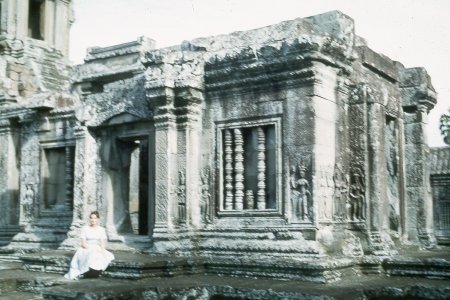
| 2001 - Me sitting the same place.
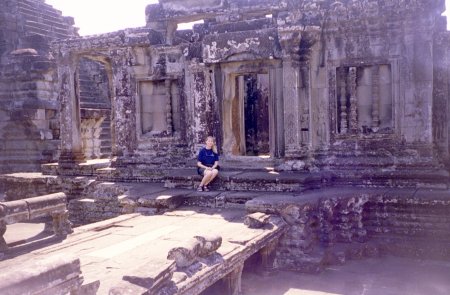
|
PUT PIX 153 to 164 here
Back to top
2001 Vietnam and Cambodia Photo Album - Page 153
.jpg)
Back to top
2001 Vietnam and Cambodia Photo Album - Page 154
.jpg)
Back to top
2001 Vietnam and Cambodia Photo Album - Page 155
.jpg)
Back to top
2001 Vietnam and Cambodia Photo Album - Page 156
.jpg)
Back to top
2001 Vietnam and Cambodia Photo Album - Page 157
.jpg)
Back to top
2001 Vietnam and Cambodia Photo Album - Page 158
.jpg)
Back to top
2001 Vietnam and Cambodia Photo Album - Page 159
.jpg)
Back to top
2001 Vietnam and Cambodia Photo Album - Page 160
.jpg)
Back to top
2001 Vietnam and Cambodia Photo Album - Page 161
.jpg)
Back to top
2001 Vietnam and Cambodia Photo Album - Page 162
.jpg)
Back to top
2001 Vietnam and Cambodia Photo Album - Page 163
.jpg)
Back to top
2001 Vietnam and Cambodia Photo Album - Page 164
.jpg)
What a great tour and what an experience to see this wonder of the world. But the experience was tarnished. Yes, the souvenir sellers have given me a story to tell. This is the first time that this has happened. Damn tourists teaching these children awful things. So here's the story.
After we saw the sunrise over Angkor Wat, we went across the street to eat breakfast. A boy attached himself to me and seemed to make it a personal goal of his to get me buy something. In fact, we were accosted by these (rude) post card kids. OK, so they are poor, and they need the money, and maybe their parents beat them if don’t come home with the money. I don’t think they really know what they are saying.
First he asks "Where you from?"
I say "America."
Then he started impressing me by telling me everything that they know about my country. "Your country has 50 states" "Population is 300 million" and they badger you about buying something.
Kate warned us not to promise anything – do not promise to buy later or they will remember and really get mad at you if you don’t buy. Well, I did not promise anything. I kept saying "No" "No" "No" over and over again. I did not want to buy anything. Well, thank goodness Kate also warned us that some kids have really learned to say some very rude, bad things. I think I had the worst, rudest boy walking beside me. (I found out later that his name is "Peal") This boy had a lot of anger. He was horrible, but Kate told us that we may encounter something like that.
This boy started telling me "You, lie. You say you buy, then you no buy."
I told him that I never said I would buy. I told them that I was going to go back to the table to finish my coffee.
He starts in with "You lie. You go to hell. I hope your country get bombed again and you die and go to hell."
Yup, that’s a pretty bad thing to say. I think they’ve learned to say things like that to get a reaction out of people. I had no reaction. I just looked and said "I’ll pray for you. I know you’re a good boy, I know you have a good heart so I will pray for you." He did not like that at all.
He was very angry and yells out "you no pray for me or anybody".
So sad. These kids seem so very desperate. They force something in your hand, then they won't take it back - they want money instead. I wonder how they learn those awful words and things to say. Maybe they learned some of it from tourists. Yup, that’s a possibility. Other things they say:
You buy postcard?
If you buy, you buy from me
Madam, you want to buy a scarf?
OK, you buy from me Madam
OK, you need flute?
You buy souvenir, but do not buy from me!
You say you buy from me!
You like this? Ok you buy one, one dollar.
You look, but you do not buy!
I say "No, I do not need one". He says "You do not need one, you need two!"
Kate said that they do not really have a word that equals "Please." Savy came up with one, but agreed that they do not really ever use the word.
There is a half marathon that starts right here in front of Angkor Wat tomorrow to raise money for victims of land mines. The sign said " Ban the use of Anti-personal Land Mines. Siem Reap, December 2, 2001." And "Angkor Wat International Half Marathon 2001. To run for love, artificial limbs for victims of land mines."
It was US$20 to register. I told Adam that I would sponsor him if he wanted to run. So he was there in front of Angkor Wat at 6 am the next day, ready to run, but you couldn’t register the day of the race. You had to do the night before. Oh well, it was a nice thought.
Back to top
2001 Vietnam and Cambodia Photo Album - Page 187
Angkor Thom
Saturday afternoon we saw Angkor Thom. It means "Great City."
Built end-12th to early 13th century (1181)
Creator was Jayavarman VII, the greates of al Khmer kings, who died about 1220. Convinced he was a living Buddha, he developed a megalomania and build temple almost in a frenzy.
A four-sided wall encloses 145 hectares (360 acres). Each side of the wall is 3 km (1.9 miles long). A moat that is 100 meters (328 feet) wide surrounds the wall.
It may have supported a population of million people.
Stone figures lead you to the five gopuras (gates) to the city. The path leading to the south gate has a rows of 54 stone figures on each side - gods on the left and demons on the right. My grandfather's picture of this gate shows a dirt path about 10 feet wide. My picture shows a road as wide as possible between the stone figures.
Each of the five gates are 23 meters (75 feet) high and have four stone faces facing each direction (N, S, E, and W).
Angkor Thom major structures:
Bayon - a temple at the center of the city of Angkor Thom. Massive towers rise around a 16-sided central sanctuary with a small shrine on each side. When we were on the third level, I climbed up (about 12 feet of steep steps) to look inside a shrine. A quiet nun inside startled me. She invited me inside to light an incense stick and say a prayer. I hope Buddha didn't mind that I prayed to my Christian God.
Per Savy, there are 49 towers (book says 54 but Savy said the other five are the gates). Each tower has four faces carved into the stone so there are about 200 faces. The faces are the face of the king, charity, compassion, and sympathy, and equanimity, per Savy. The book says the iconography of the faces is widely debated. "The faces with slightly curving lips, eyes placed in shadow by the lowered lids utter not a word and yet force you to guess much" (P Jennerat de Beerski in the 1920's). These faces reflect the famous "smile of Angkor."
Back to top
2001 Vietnam and Cambodia Photo Album - Page 178
.jpg)
Back to top
2001 Vietnam and Cambodia Photo Album - Page 176
.jpg)
Back to top
2001 Vietnam and Cambodia Photo Album - Page 177
.jpg)
Terrace of the Elephants - 300 meters (984 feet) long. We walked from Bayon to this terrace around 5:15 p.m.. The sun is lower in the sky and the temperature is pleasant. Incredible tri-level platforms which formed the base of wooden pavilions which were highlighted with gold. Life-size stone elephants adorn the facade. Savy said that on New Years Eve people sit all along here to watch Apsaras dancing.
Terrace of the Leper King - so named for the statue on the platform. There is much debate on how it got the name. The statue sits on a base 25 meters (92 feet) on each side and 6 meters (20 feet) high. There are bas-reliefs inside and outside the walls.
Baphuon - closed for restoration at a cost of US$10 million. Expected to be complete in 2004.
Across from the terrace are jails. People were put in there for 3 days. If they come out well, they are innocent.
Back to top
2001 Vietnam and Cambodia Photo Album - Page 179
.jpg)
The stone here is not good quality and they use smaller stones so they are likely to collapse.
The king promoted himself to be the God King Jayavarman VII wanted the people to worship him.
As I walk around this stupendous place, I am drawn into my own sense of awe trying to imagine life long ago of a million people living here in 1100. The loud hissing sound from the
Cicada bugs snapped me back to the reality of life in 2001.
About our guide Savy:
He is by far the best guide. He knew the best time to visit each temple. We saw the sun rise over Angkor Wat from 6 to 7 am, then ate a wonderful breakfast, the toured the Wat from 8 till 11.
There was maybe one other tour group at Angkor Wat at that time.
We went back to the hotel for a rest, then around 3 ventured out again.
We saw Angkor Thom in the shade (I saw many other tourists walking around the Elephant Terrace in the hot unbearable sun as we drove by to visit other temples.) When we saw it, it was warm but not intolerable. I was comfortable wearing long pants. The sun was low and it was maybe 25 (80 F) with 98% humidity.
I am very impressed with his knowledge and the way he presents the information. At one temple he was spouting off statistics. As he was talking, I matched every number that he said with the statistics that I was reading in the Angkor book. He added a lot to the information that was in the book. He does such a good job explaining these stone carvings that people in the group are really learning how to look at the stories and appreciate what we see.
People are even asking questions about the things on the walls!
He knows how to lead the group to the best spots in the temples and how to take us on the side of the road where post card sellers are not allowed to go.
For dinner that night, I went with Chris, John, and Keith to a buffet dinner where we saw traditional dancing. The food was fabulous and the dancing beautiful.
Back to top
Day 15 (tour day 6) Vietnam Cambodia Tour Sunday Dec 2 - Siem Reap,
Banteay Srei
Day 15 of my Vietnam/Cambodia trip is Day 6 of the Cambodia Road to Ankor Tour.
My Notes
9 am - bus ride to Banteay Srei, one of the finest examples of Classical Khmer Art. It means "Citadel of the Women."
It is about a 1 hour ride, but our bus broke down. The bus driver is a mechanic too so they started working on the brakes at the side of the road. Then the children start appearing. They come out of nowhere to sell you things.
Kate made a phone call and another bus arrived to take us to the Banteay Srei temple.
Back to top
2001 Vietnam and Cambodia Photo Album - Page 188
.jpg)
What can say about Benteay Srei. WOW.
Banteay Srei
"Intricate decoration carved in pinkish sandstone that covers the walls like tapestry."
Built in the late 10th century (967). It was discovered in 1914, but not cleared till 1924.
My grandfather visited it in 1960 and here I was in 2001.
The east gopura (gate) has two triangular shaped frontons, which are framed with large scrolls.
Grampa took a picture of the second one so I took the same picture. (This one is also featured in the Angkor book on page 250.) It shows elephants sprinkling holy water over the head of the Sheba God. I couldn't tell that there was any deterioration in the carving.
Back to top 2001 Vietnam and Cambodia Photo Album - Page 180
.jpg)
Back to top
2001 Vietnam and Cambodia Photo Album - Page 181
.jpg)
Back to top
2001 Vietnam and Cambodia Photo Album - Page 182
.jpg)
Back to top
2001 Vietnam and Cambodia Photo Album - Page 183
.jpg)
| My Grandfather's picture in 1960.Banteay Srey.
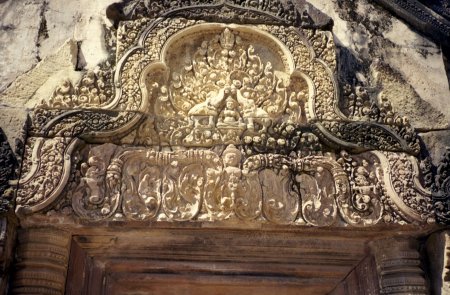
| My picture 2001.
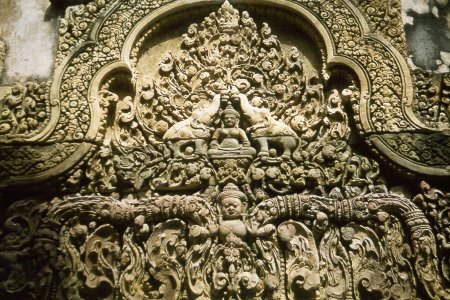
|
Back to top
2001 Vietnam and Cambodia Photo Album - Page 184
.jpg)
Swim Baray Lake
After the temple, we went to Baray Lake to swim.
Kate bought some BBQ chickens and fish at a road-side stand. We went down to the water. The lake is surrounded by cement, so you have to walk down steps along the slanted edge of the lake, then wade in water that is ankle deep, then balance along a 6-inch wide board that is about 3 inches above the water. There was about a 30 foot walk to the covered platform. Here we are carrying our most expensive cameras. No one fell in.
About half the people in our group swam in the fresh water lake. The men can
swim in the smallest swim suit, but the women wear their clothes or a sarong. I hung out in a hammock until they delivered our food down at the water. The chicken was wrapped in big green leafs and there were hot hot bags of rice. Yum.
Swim was refreshing.
After swimming, go back to the hotel to change. I was feeling so tired I did not go to the children's orphanage to see the dancing. I felt like I was getting a cold, so I stayed in to take a nap.
Back to top
2001 Vietnam and Cambodia Photo Album - Page 186
.jpg)
7 p.m. the last night of the tour. Kate took us to a great restaurant for the farewell dinner. 5 folks were finishing the whole Indo-China loop trip. That is a five
week (I think) venture. These countries and food and people are so beautiful, but it does get to you after awhile. It
has been 3 weeks for me. I guess I have to say that I am glad to be going home tomorrow. We were so lucky with weather on this trip. Virtually no rain, pleasant temperatures, but very humid in Cambodia.
Many beautiful temples. "One need never say good-bye to Angkor. For its magic will go with you wherever fate and the gods may take you to colour your thoughts and dreams to life's every end." (HW Ponder, Cambodian glory: The Mystery of the Deserted Khmer Cities and their Vanquished Splendour: and a Description of Life in Cambodia Today, London, Thornton Buttworth, 1936, p. 316.)
Back to top
Day 16 (tour day 7) Vietnam Cambodia Tour Monday Dec 3 -
Fly Siem Reap to Bangkok to Kuala Lumpur, Malasia to Taiwan to Atlanta
Day 16 of my Vietnam/Cambodia trip is Day 7 of the Cambodia Road to Ankor Tour.
My Notes
Back to top
2001 Vietnam and Cambodia Photo Album - Page 189
.jpg)
Back to top
2001 Vietnam and Cambodia Photo Album - Page 190
.jpg)
Back to top
2001 Vietnam and Cambodia Photo Album - Page 191
.jpg)
mw
nxx
oyy
pzz
This page and all other pages in the
http://www.mytrips.com web site, along with the journals, images, and photos are Copyright ©
2025 by Suzanna Travels. All publication rights are reserved. Email: web@
mytrips.com Remove the space after the @

.jpg)